Used Hyundai i30: Common Problems and Which Years to Buy
What to check on a used i30, including the i30 N, what a problem looks like, and when to walk away.
Covers
- FD 2007–2012
- GD 2012–2017
- PD 2017 on
- i30 N 2018 on
Last updated
Common Problems on a Used Hyundai i30
The most commonly reported problems on a used Hyundai i30 are low-speed judder and hesitation from the dual-clutch automatic (DCT) fitted to some models, oil use on some engines, and a clunk through the steering on rough roads. On an i30 N, look for tunes, lowered suspension, track use and a worn clutch.
Which generations each is reported on is in problems by generation, below.
Low-Speed Judder and Hesitation from the Dual-Clutch Automatic (DCT)
Some i30s have a dual-clutch automatic (DCT), which works like two manual gearboxes with computer-controlled clutches. It's quick and efficient once moving, but at walking pace the clutches have to slip, and as they wear or overheat in stop-start traffic, take-offs turn juddery and hesitant.
Test it where it struggles: crawl in traffic, pull away gently from a stop, and reverse up a slope or driveway. Shuddering, hesitation before it moves, jerky changes in low gears or a warning on the dash are all signs of trouble. A slight hesitation that's smooth once moving is normal for this kind of gearbox.
Ask whether the DCT has had any repairs or software updates, with receipts. Clutch or control-unit repairs are expensive, so if it judders, have a mechanic check it or price the repair into your offer.
Oil Use
Some engines in the i30 are known to burn oil between services. A little is normal, but an engine that needs regular top-ups can run low without warning, and running low on oil damages an engine fast.
Pull the dipstick: the level should sit between the marks, and the oil should be brown rather than black. Ask the seller how often they top it up, and watch the exhaust at start-up and when you accelerate for blue-grey smoke.
Check the service history for regular oil changes, as skipped services make it worse. Heavy oil use can mean worn engine internals, so if the seller is topping it up between services, have a mechanic check it before you buy.
A Clunk Through the Steering
Some i30s develop a clunk or knock felt through the steering wheel on rough roads, usually from a worn part in the steering column or front suspension. It's often a modest fix, but steering faults shouldn't be ignored.
On the test drive, find a rough or patched road and drive it slowly with the windows down. Feel for a knock through the wheel, and listen for clunks from the front as you go over bumps and turn the wheel at low speed.
Ask whether any steering parts have been replaced, and check for open recalls or service campaigns with a dealer, using the VIN. If it clunks, have a mechanic find the cause before you buy.
Tunes and Track Use on an i30 N
The i30 N is built to be driven hard, and some have done track days or been tuned or lowered. That's tough on the clutch, brakes, tyres and gearbox, and a tune can void the warranty and must be declared to insurers.
Look for an aftermarket air intake or an extra box wired into the engine, lowered or aftermarket springs, heavy wear on the inside edges of the tyres, and dark brake fluid. On the drive, check the clutch isn't slipping: in 4th at 50 km/h, floor it, and the revs shouldn't rise faster than the speed.
Ask directly about track days and tunes, and get the answers in writing, along with engineering sign-off for any lowering where your state requires it. A hard-driven i30 N is worth a mechanic's inspection before you buy.
Hyundai i30 Problems by Generation
What owners and reviewers report on each generation. A problem is listed when two or more separate sites report it on that generation, and we cite known external sources (how we check our facts). It's what's been reported, not what every car has: plenty never have it, and the car you're looking at may have something else.
FD (2007–2012)
Mostly a 2.0-litre petrol or 1.6-litre turbo-diesel, with a manual or four-speed automatic.
- Harsh or flaring gear changes from the four-speed automatic, traced to a defective valve body, often from 60,000–90,000 km. [1]
GD (2012–2017)
1.8-litre petrol, 1.6-litre and 2.0-litre direct-injection (GDI) petrols, and a 1.6-litre turbo-diesel.
- High oil use, and knocking from the engine (piston slap), on the direct-injection petrols, the subject of a class action. [2]
PD (2017 on)
2.0-litre petrol, 1.6-litre turbo petrol, 1.6-litre turbo-diesel and later a 1.5-litre turbo mild hybrid; manual, automatic or a dual-clutch automatic (DCT).
Which Hyundai i30 Years to Avoid?
No single Hyundai i30 year stands out as one to avoid, but owners and reviewers report different problems on each generation: rough shifts from the FD's four-speed automatic, high oil use on the GD and PD's direct-injection petrols, and low-speed judder from the PD's dual-clutch automatic on the 1.6 turbo. Newer ones usually have fewer kilometres and less wear, and the newest may still have some new-car warranty left. Whatever the year, a car's condition, service history and recalls tell you more than its build date. This page gives each generation's age, typical kilometres, ANCAP rating and warranty.
- FD (2007–2012). 14 to 19 years old, typically about 180,000–240,000 km. ANCAP ratings: 4 out of 5 (2007) for cars built to March 2008; 4 out of 5 (2008) for cars built from June 2008 to September 2009 with front airbags only; 5 out of 5 (2008) for hatches built from June 2008 with stability control and curtain airbags; 5 out of 5 (2009) for i30cw wagons with curtain airbags. Stability control is standard on the SLX and Elite and optional on the SX; i30cw wagons have it as standard. At this age, condition and history count for more than the year: look hard for rust, worn suspension and leaks, and check whether a timing belt (if it has one) has been replaced.
- GD (2012–2017). 9 to 14 years old, typically about 110,000–180,000 km. ANCAP ratings: 5 out of 5 (2012) for cars built to December 2014; 5 out of 5 (2014) for cars built from January 2015. Stability control is standard. Most have done enough kilometres for wear items to come due: check the service history for regular servicing, and whether tyres, brakes and the battery need replacing.
- PD (2017 on). Up to 9 years old, typically up to about 110,000 km. ANCAP ratings: 5 out of 5 (2017) for hatches other than the i30 N, until it expired in December 2024; 5 out of 5 (2017) for wagons, until it expired in December 2024; cars built since are unrated. Stability control is standard. On hatches, AEB is on some variants and standard from July 2020 builds; wagons don't have it. The current model. Hyundai's new-car warranty is 5 years with unlimited kilometres for cars sold from 2007 (7 years for cars first registered from June 2025 with every service at a Hyundai dealer), so ones first sold from 2021 may still be covered. On older ones, check the service history and whether tyres, brakes and the battery are due.
- i30 N (2018 on). Up to 8 years old, typically up to about 100,000 km. The current model. Hyundai's new-car warranty is 5 years with unlimited kilometres for cars sold from 2007 (7 years for cars first registered from June 2025 with every service at a Hyundai dealer), so ones first sold from 2021 may still be covered. On older ones, check the service history and whether tyres, brakes and the battery are due.
Kilometres are at the Australian average of about 12,600 km a year. Well above that means harder use; well below, ask why.
Warranty terms are from Hyundai's warranty page, as at November 2026, for private buyers. The warranty runs from when the car was first sold or registered, which the service book shows.
For the i30 you're looking at, a Shufti Tailored check works from the car itself: its listing, kms, PPSR and recalls by VIN, your photos checked, and a repair cost and offer.
Hyundai i30 General Inspection Guide

A guide to checking for Hyundai i30 problems, built on the used car buying checklist for any car. It can't cover every problem reported across its years in one viewing.
- FD 2007–2012
- GD 2012–2017
- PD 2017 on
- i30 N 2018 on
Tick it if it's fine. Cross it if it isn't, and note what you found so you can price it into your offer.
- Safety critical
- Affects how safely it drives or protects you in a crash. Best to have a mechanic check it before you buy.
- Negotiate
- Costs money to fix, from wear to major repairs. Use it as negotiation leverage.
01
Exterior
4 checks
01
Exterior
4 checks
02
Under the Bonnet
4 checks
02
Under the Bonnet
4 checks
03
Underbody and Wheels
4 checks, 1 safety critical
03
Underbody and Wheels
4 checks, 1 safety critical
04
Interior and Electrics
4 checks, 2 safety critical
04
Interior and Electrics
4 checks, 2 safety critical
05
Test Drive
4 checks, 1 safety critical
05
Test Drive
4 checks, 1 safety critical
06
Documentation
4 checks
06
Documentation
4 checks
Get this free inspection guide on your phone.
Work through the Hyundai i30 General inspection guide on your phone at the car. Capture images, audio and note what you find.


Scan to get the app
Rather have it on paper?
Stay Safe
Never go under a car held up only by a jack, and never open the radiator or coolant cap on a hot engine. Keep hands, hair and loose clothing clear of fans and belts when the engine is running, and do checks under the bonnet with it switched off where you can. On the test drive, hold a current licence, confirm the car is registered and insured, obey road rules, and only brake hard when the road behind is clear. Meet in a safe, public-facing place, take someone with you, and don't carry large amounts of cash to a viewing.
Disclaimer. Shufti is not affiliated with or endorsed by Hyundai; Hyundai and i30 are trademarks of Hyundai Motor Company. Figures are counts from Shufti's analysis of official records and published reports, not a statement that any particular vehicle is affected. This checklist is general information only and is not professional, mechanical, legal or financial advice. It covers common checks, not every possible fault, and a car can pass every item here and still have problems. It is not a substitute for a pre-purchase inspection by a qualified mechanic, which is worth considering before you buy, especially if anything tagged Safety critical turns up. Repair costs vary widely; get your own quotes. Roadworthy, registration and transfer rules differ by state, so check with your state road authority. Private sales generally don't come with the consumer guarantees that apply when you buy from a dealer. You use this checklist at your own risk and, to the extent permitted by law, Shufti accepts no liability for any loss, damage or injury arising from its use.
What the General inspection guide can't tell you about the i30 you're looking at
11+
recalls on i30s built since 2007
13
common faults reported on i30s built since 2007
371
owner complaints on i30s built since 2009
What's each fault worth?
Shufti's negotiation coach turns it into leverage.
Money owing, stolen or a write-off?
A tidy car can hide all three.
A Tailored check in the Shufti app covers all of that, plus:
- Guided checks for the exact car you're inspecting
- Crosschecks 3M+ recalls and owner complaints
- Spots issues from your photos and audio
- Test drive routes with turn-by-turn navigation
- Negotiation coach with repair cost estimates
- PPSR and government recall checks included
Get a Shufti Tailored check on your mobile.
Don't drive home in a lemon.
Not sure yet? Start free with the Hyundai i30 General inspection guide, and upgrade to a Tailored check for the car you're serious about.
Start from the listing
Drop in a link from any major car sales website. Shufti retrieves the important information about your vehicle to guide you through a customised buying process.

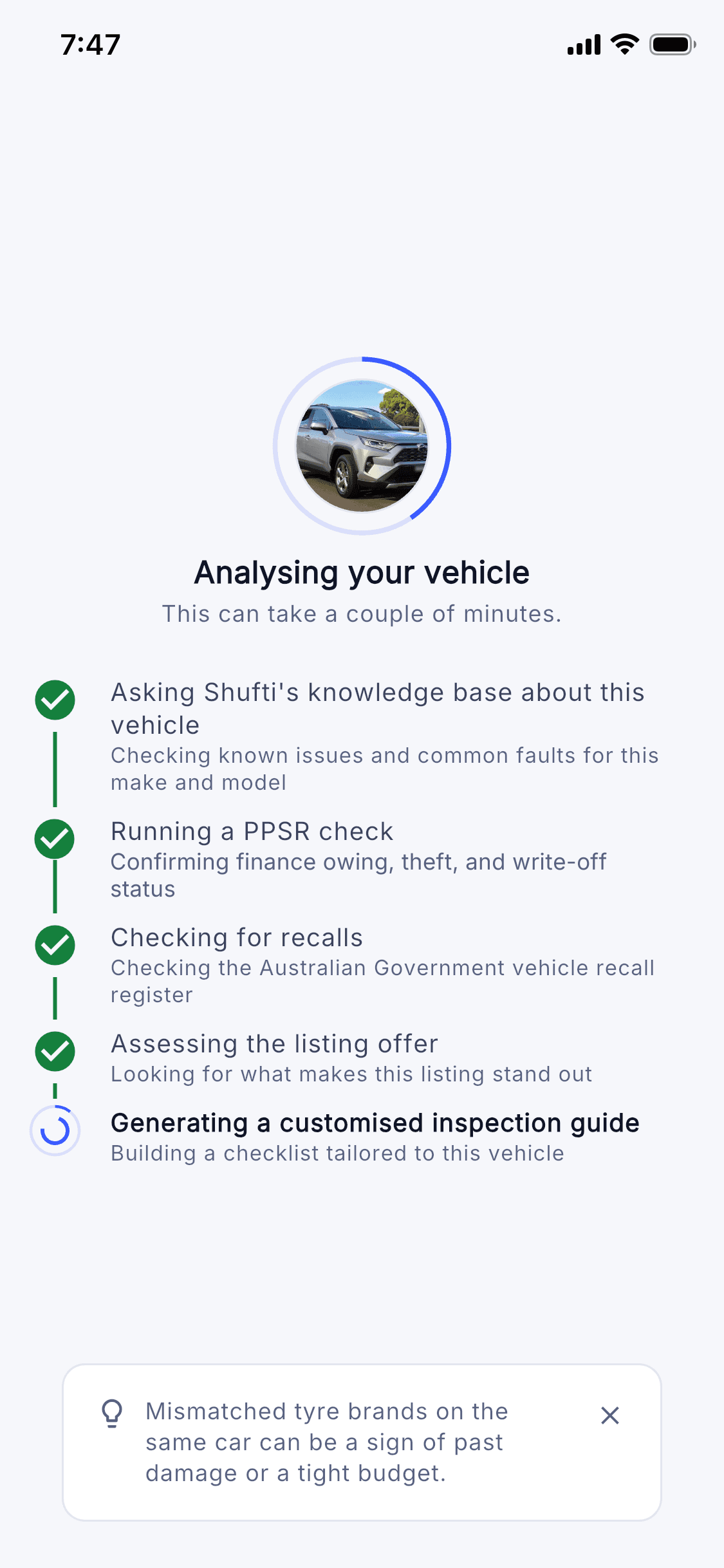
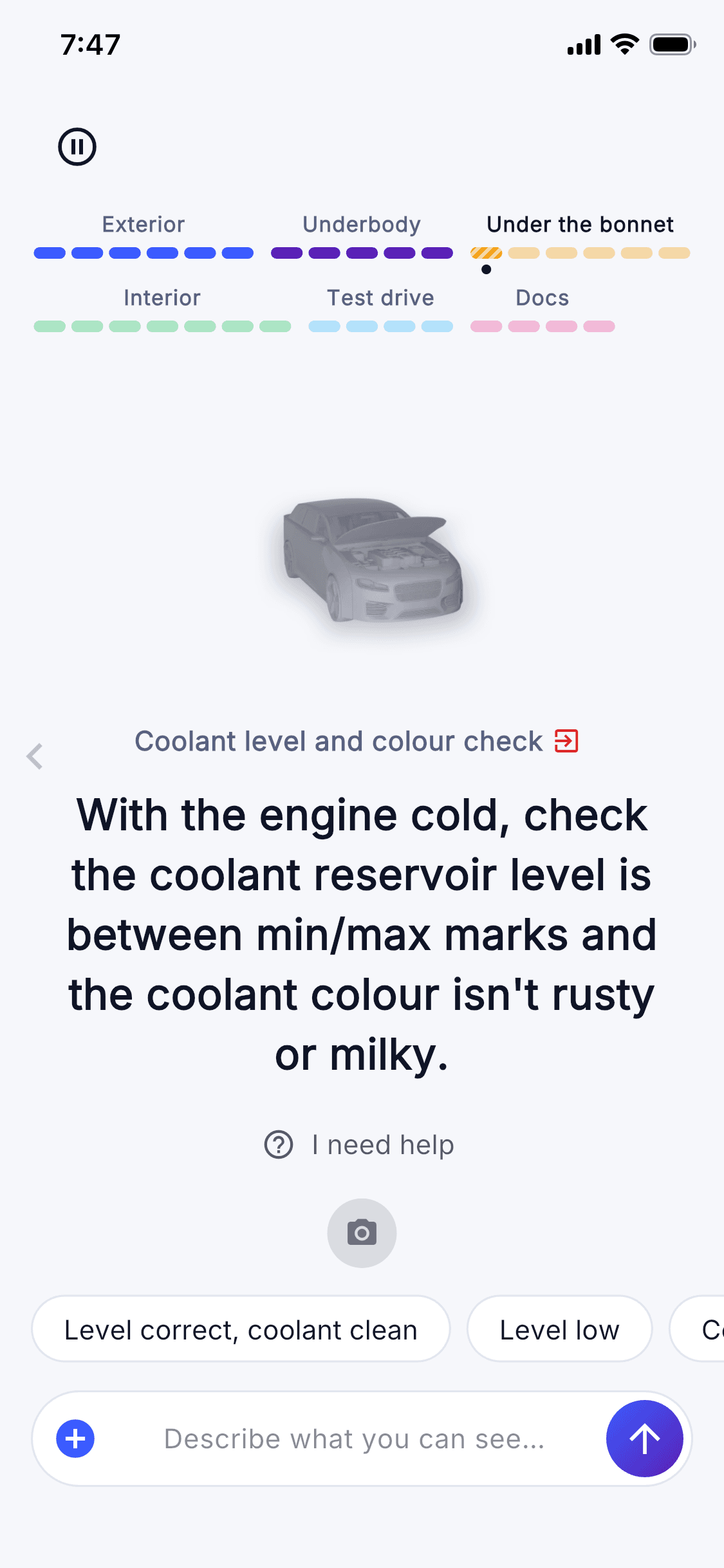
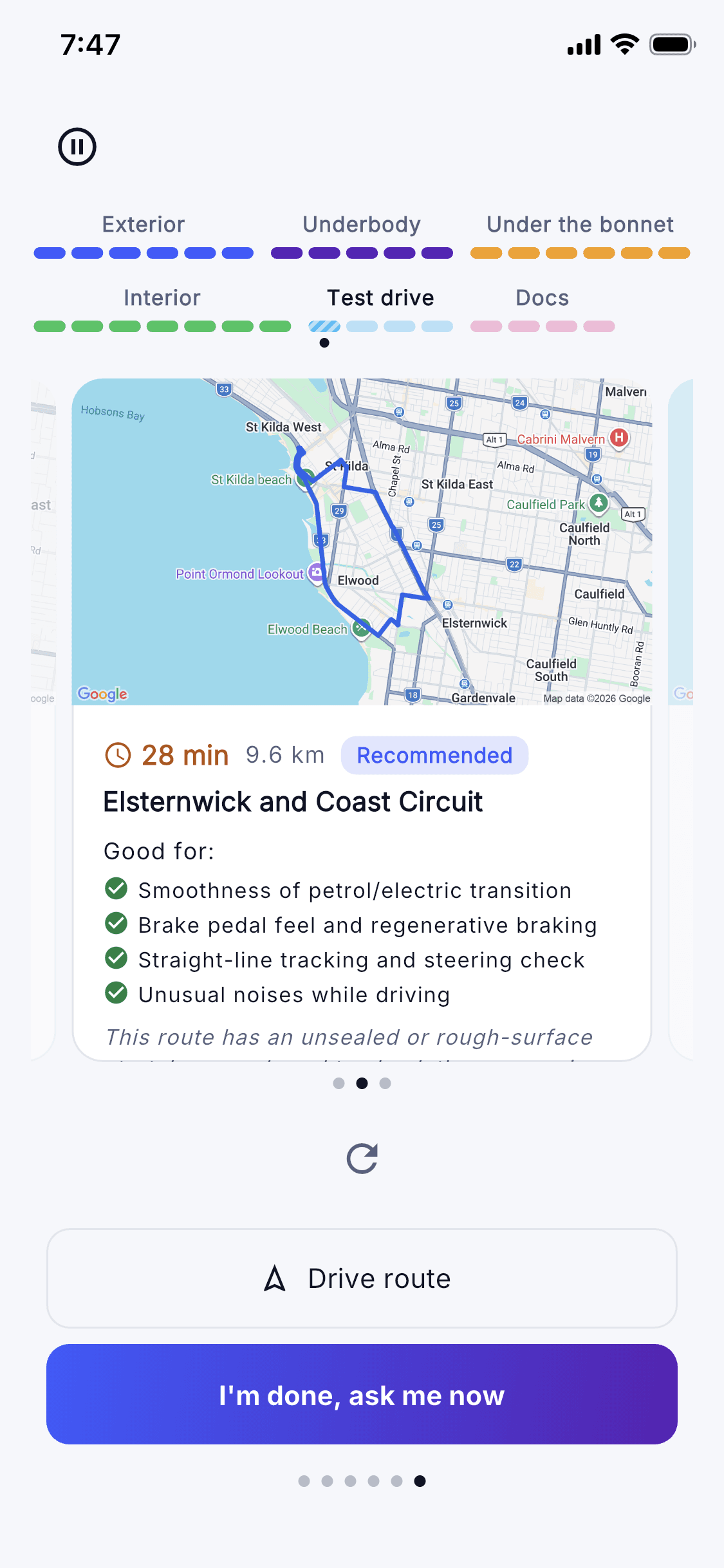
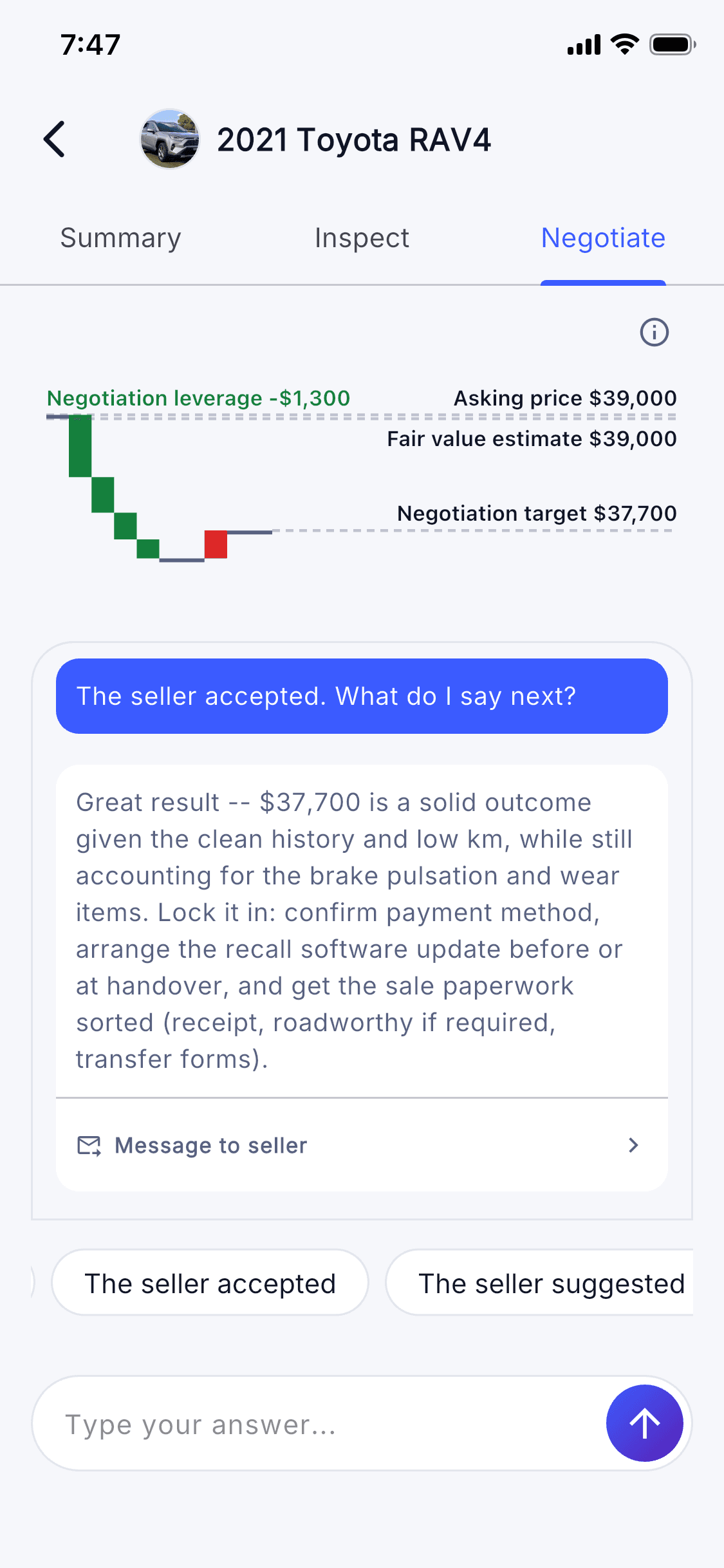
Start from the listing
Drop in a link from any major car sales website. Shufti retrieves the important information about your vehicle to guide you through a customised buying process.
* Shufti analysis, September 2026, of official recall notices, complaints lodged by vehicle owners with vehicle safety regulators, and independent reviews and owner forums. Faults are counted when two or more independent sources report them. See the recall notices for the Hyundai i30 on the government's Vehicle Recalls site, and how we check our facts.
Buying a Used Hyundai i30: Questions Answered
Is a used Hyundai i30 reliable?
It depends more on the particular car than the badge: how it was driven, loaded and serviced. Work through the commonly reported problems above, read the service history for servicing done on time, and run a PPSR check.
Which Hyundai i30 years should I avoid?
No single Hyundai i30 year stands out as one to avoid, but owners and reviewers report different problems on each generation: rough shifts from the FD's four-speed automatic, high oil use on the GD and PD's direct-injection petrols, and low-speed judder from the PD's dual-clutch automatic on the 1.6 turbo. Newer ones usually have fewer kilometres and less wear, and the newest may still have some new-car warranty left. Whatever the year, a car's condition, service history and recalls tell you more than its build date. This page gives each generation's age, typical kilometres, ANCAP rating and warranty.
This checklist covers the FD (2007–2012), GD (2012–2017), PD (2017 on) and i30 N (2018 on) Hyundai i30. Problems reported across them include low-speed judder and hesitation from the dual-clutch automatic (DCT), oil use and a clunk through the steering on rough roads.
How many kilometres is too many for a used Hyundai i30?
Kilometres matter less than how the car was driven and serviced. A high-kilometre car with a full service history can be a better buy than a low-kilometre one that's missed services or spent years on short trips. Check the history for regular oil changes, and find out whether any timing belt replacement is due, as it's a costly job.
Should I get a pre-purchase inspection on a used Hyundai i30?
It's most worth it on a car where a hidden fault could be costly. Hidden crash repairs and gearbox problems are easy to miss on a short test drive, so check panel gaps and paint closely and drive it long enough to feel every gear change. Either way, start by checking the car yourself with this checklist, so you know what to look for and whether it's worth paying a mechanic to see. See Pre-purchase car inspection: what it checks and costs
How do I check a used Hyundai i30 for money owing or a write-off?
Run a PPSR check with the car's VIN on ppsr.gov.au. It shows whether there's finance owing and whether the car has been reported stolen or written off. Run it on the day you pay. See What a PPSR check covers and what it doesn't
How do I check recalls on a used Hyundai i30?
Search the government's Vehicle Recalls site for the Hyundai i30. Each notice says which models and build dates it covers and what the fault is. A recall on record doesn't tell you whether the work was done on a particular car, so ask the seller for proof, or ask a Hyundai dealer to check the VIN.
Mechanic, Checklist or Shufti?
Here's how Shufti stacks up against your other options.
A mechanic's inspection is the most thorough, but most buyers go without one. Shufti makes sure you're well informed either way.
| Feature | Shufti $24.99 per check | Mechanic Inspection $250–350+ per booking | General Inspection Guide Free in the app or on paper |
|---|---|---|---|
Guided, model-specific checks | Yes | Yes | No |
Crosschecks over 3 million recalls and owner complaints | Yes | No | No |
Flags possible issues from your photos and recordings | Yes | No | No |
Test drive route planning and navigation | Yes | No | No |
Written inspection report | Yes | Yes | No |
Repair cost estimates | Yes | Yes | No |
Negotiation coaching | Yes | No | No |
PPSR and government recall checks included | Yes | No | No |
Plain-English explanations, not jargon | Yes | Yes | Yes |
No booking or waiting required | Yes | No | Yes |
Not ready yet? Start with the free General inspection guide for your car's model.
Scan to get the app
Comparing Other Cars?
Looking at a different car? Use the used car buying checklist for any car or browse problems and checklists by model.